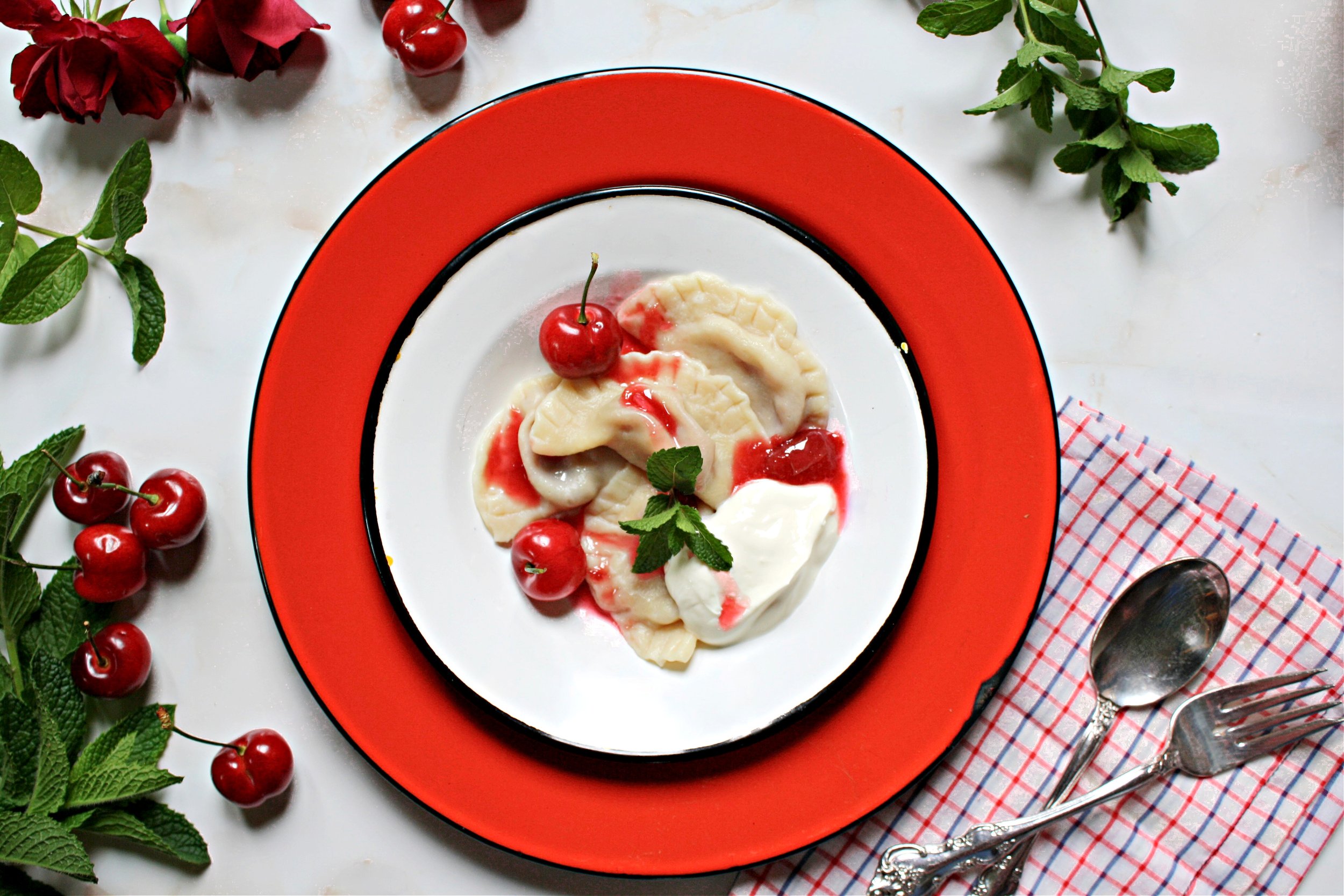
Salad Olivier

Full article is available via The Nosher
...This salad was first prepared by Lucien Olivier in the 1860’s. Olivier was the French chef of a famous restaurant in Moscow called The Hermitage, hence the very French name for this now popular Russian salad. Also, Russians were obsessed with French culture at that time. Salad Olivier was an immediate hit, and it became the restaurant’s signature dish. Originally, it was made with crayfish, capers, and even grouse. After the revolution, simpler and easier to come by ingredients were more commonly adapted into the recipe. These ingredients are also all conveniently available in the dead of winter.
The popularity of the salad spread beyond Russia to Eastern Europe, the Balkans, and even to Iran and Pakistan. In fact, in our family we call this dish Salad de Boeuf (pronounced as “de beff”), which is what this salad is inexplicably called in Romania and Western Ukraine. Boeuf means “beef” in French, and this salad contains no beef at all. In each geographic locale, the salad might differ slightly. Sometimes the potatoes are mashed instead of cubed, or there’s shredded chicken instead of smoked meat, or sometimes there’s no meat at all, as was the custom in our family. What makes this type of potato salad uniquely a Salad Olivier is the presence of potatoes combined with carrots, peas, pickles, and hard boiled eggs. Everything should be chopped to roughly the same size. The appeal of something seemingly odd and vaguely average is ultimately mysterious, but the combination of hearty firm potatoes, sweet cooked carrots, crisp pickles, earthy peas, and silky eggs in a creamy tangy dressing just works. The ingredients meld all together, each losing its own particular edge to combine to make a complete range of salty, sweet, tangy, satisfying tastes in each bite. I think this salad’s enduring and far-reaching popularity proves that it’s eaten for more than tradition’s sake.
If you’re going to attempt to make this for the first time there are a few things to know. For one, this recipe reflects how my family likes this dish. If you’ve had this before it might be slightly different from what you’re used to. More importantly, the quality of each ingredient matters to the overall success of the dish. I like to use Yukon Gold potatoes because they hold up well and have a pleasant rich sweetness, but you can definitely try it with your favorite potato. Taste the carrots before you cook them; they should be sweet and flavorful, not the dull astringent variety you sometimes end up with. The best pickles for this dish are ones that come from the refrigerator section, that still have a crunch, and are brined in salt with zero vinegar added. They’re also known as “naturally fermented” pickles. The type of mayonnaise you use is also key, and I swear by Hellmann's/Best Foods brand mayo.
Salad Olivier
Serves 6-8
Ingredients:
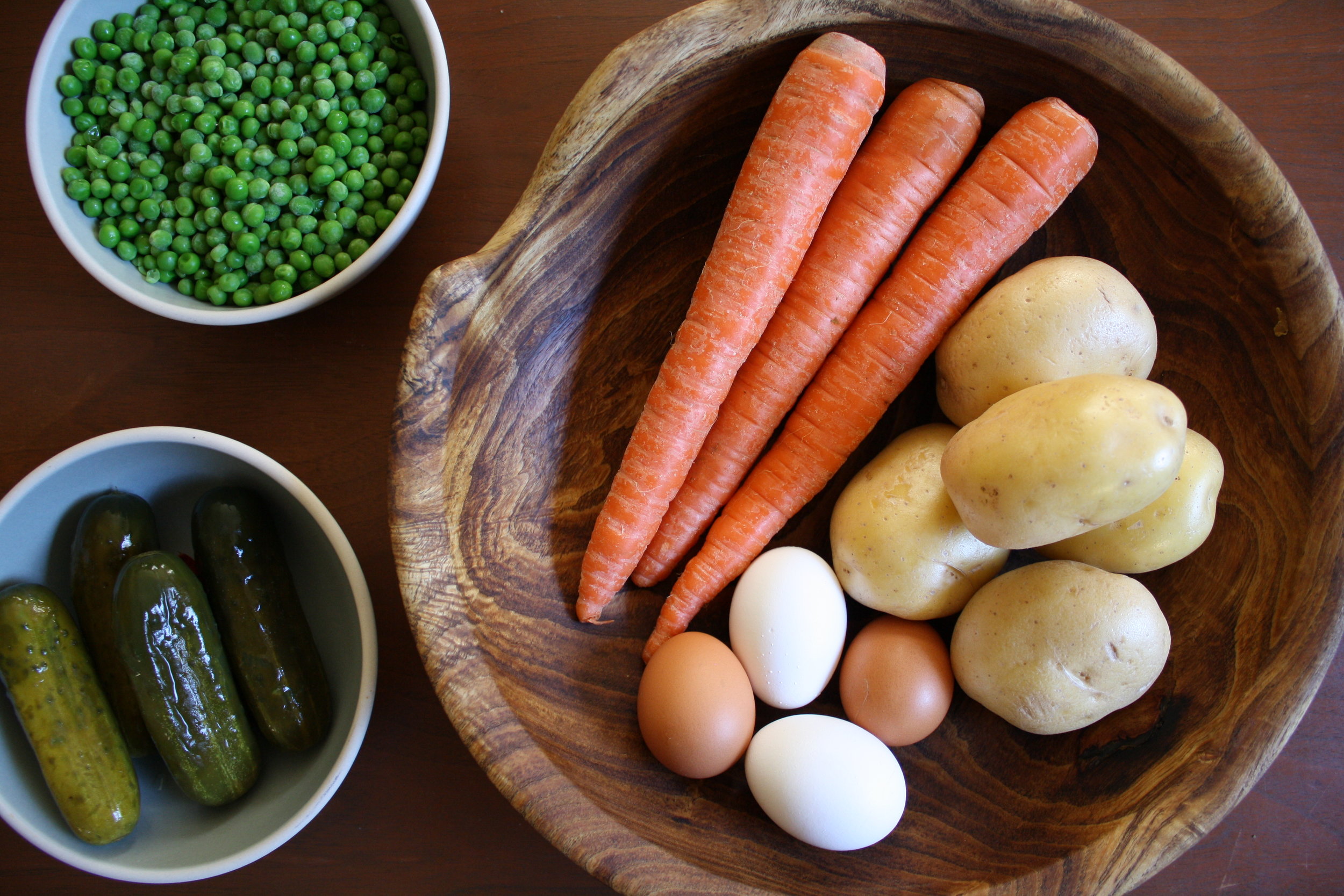
- 1.5 lbs Yukon Gold potatoes, about 4-5 medium
- 3 large carrots
- 4 large eggs
- 3 large dill pickles, or to taste (use naturally fermented/brined pickles)
- 1 cup frozen peas, thawed (you can substitute with fresh cooked peas or even canned)
For the dressing-
- 1 cup good quality mayonnaise
- 2 tablespoons olive oil
- Juice of ½ a lemon, or to taste
- 1 Tablespoon pickle liquid (optional)
- ¾ Tablespoon kosher salt, or to taste
- 2 Tablespoons chopped fresh dill (optional)
Directions:
Wash the potatoes and carrots well. Add them to a pot, and fill with water. Bring the water to a boil, and boil the potatoes and carrots until easily pierced through with a knife. The carrots will cook faster, about 15-20 minutes. Once they’re tender remove them from the pot and allow the potatoes to finish cooking, about 15-20 minutes more, or 30-35 minutes in total. Be careful not to overcook your potatoes and carrots, you do not want them to end up as mush in the salad. Once cooked, set aside to cool or refrigerate. This step can be up to 2 days in advance.
While the potatoes and carrots are cooking, hard boil your eggs and allow them to cool.
Once cooled, carefully remove the peels from your potatoes. You can either remove or keep the peel on your carrots depending on your preference.
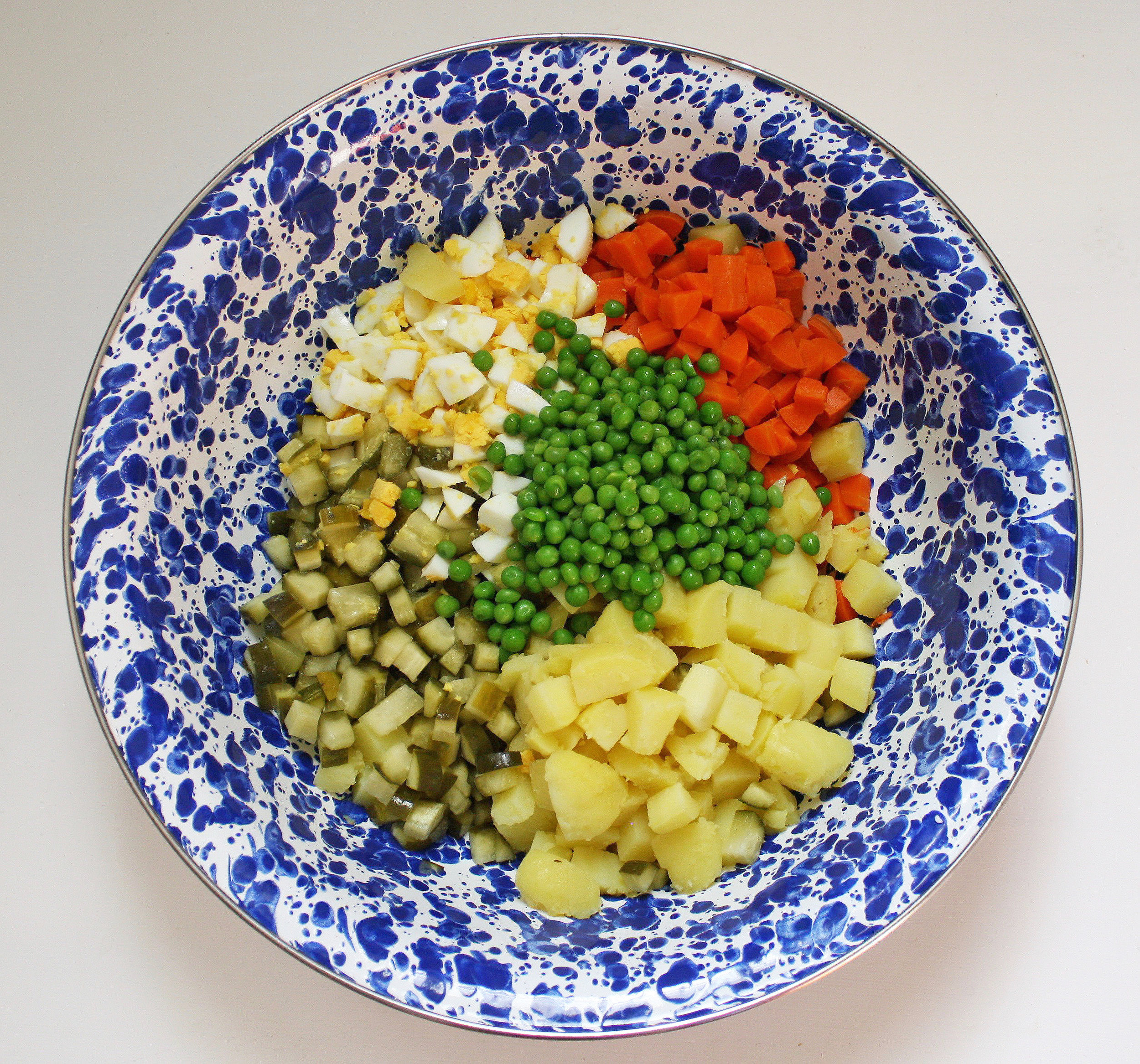
Cube all of the potatoes, carrots, and eggs to the same size. I like a medium-small dice.
Dice the pickles slightly smaller than the other ingredients as they have a stronger flavor.
Add the cubed potatoes, carrots and eggs to a large bowl. Add the pickles and thawed peas to the bowl.
In a separate small bowl, combine all of the ingredients for the dressing and whisk together. Taste and adjust accordingly.
Add the dressing to the potato mixture, and carefully stir until everything is fully coated in the dressing. Taste and add more salt if desired (every brand of kosher salt differs in salinity). If you want it creamier/tangier, add more mayonnaise or lemon juice. You can also use sour cream or yogurt if desired.
Allow the salad to chill for at least one hour before serving so that the flavors can all come together. This salad can be made up to a day in advance, and stores well for 2 days. You can also make this without the dressing up to 3 days in advance, then add the dressing before serving.
Before serving, transfer the salad to a serving bowl. This salad is known for being creatively decorated and festively garnished with fresh herbs, vegetable roses, etc. You can doll it up in any way you like.

Baba's House